

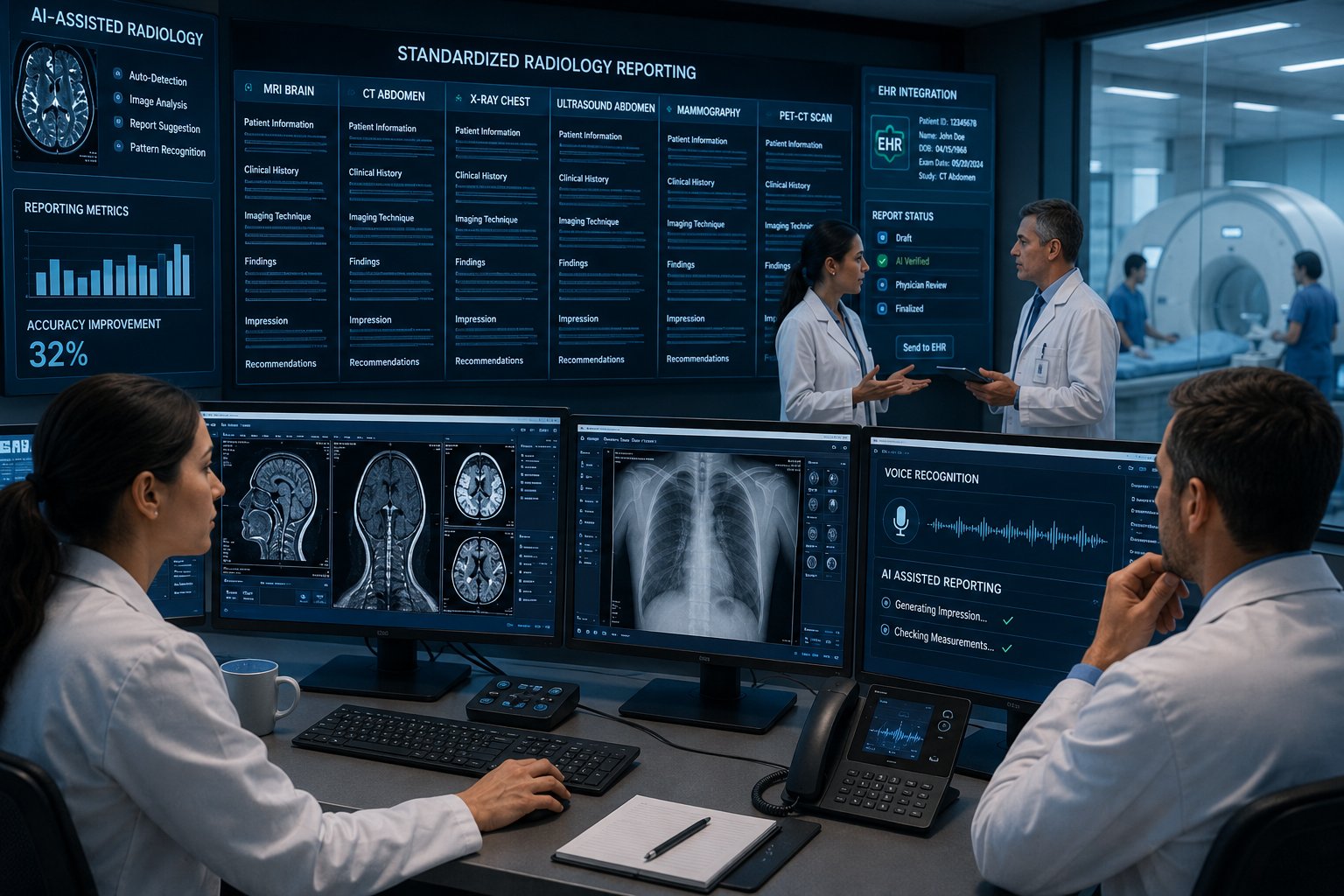
Radiology reports are an essential part of modern healthcare documentation. They help physicians understand imaging findings and support accurate diagnosis and treatment planning. Standard formats for radiology reports improve consistency, reduce communication errors, and enhance workflow efficiency across healthcare facilities. Today, hospitals and imaging centers rely heavily on Radiology Report Transcription, Radiology Reporting Services, and Radiology Report Formatting Services to maintain high-quality medical documentation.
A well-structured radiology report ensures that all important clinical details are presented clearly and professionally. Standardized reporting formats also help physicians quickly identify abnormalities, impressions, and recommendations without confusion. As healthcare systems continue to adopt digital technologies, structured radiology reporting has become increasingly important for improving patient care and operational efficiency.
Standardized radiology reports create a consistent structure for documenting imaging findings. This consistency improves communication between radiologists, referring physicians, and other healthcare professionals. A clear and organized report format helps physicians make faster clinical decisions and minimizes the risk of misinterpretation.
Healthcare organizations increasingly use professional Radiology Reporting Services to maintain standardized documentation practices. These services help improve report quality, reduce turnaround times, and support compliance with healthcare regulations. Standardized reports also simplify integration with Electronic Health Records (EHR) systems and Radiology Information Systems (RIS).
Most radiology reports follow a structured format that includes several important sections. Each section plays a critical role in ensuring accurate and complete documentation.
This section includes patient demographics and examination details such as patient name, age, gender, examination date, and referring physician information. Accurate patient identification is essential in Radiology Report Transcription to avoid documentation mistakes and ensure patient safety.
The clinical history explains the reason for the imaging study and provides background information about the patient’s symptoms or medical condition. This information helps radiologists interpret imaging results more effectively.
It may include details about scan protocols, imaging views, and the use of contrast material. Proper documentation in this section is supported by professional Radiology Report Formatting Services to maintain consistency across reports.
The findings section contains detailed observations from the imaging study. Radiologists describe abnormalities, anatomical structures, lesions, fractures, or other diagnostic findings in a clear and organized manner.
The impression summarizes the key diagnostic conclusions from the imaging examination. This section is often the most important part of the report because physicians frequently review it first for clinical decision-making.
Structured reporting has become increasingly popular in modern healthcare because it improves report clarity and consistency. Structured templates use predefined headings and standardized terminology, allowing radiologists to create reports more efficiently.
Benefits of structured reporting include:
Many healthcare facilities now depend on Radiology Reporting Services to implement structured reporting systems and improve documentation workflows.
Timely radiology documentation is critical for patient care. Delayed reports can slow diagnosis and treatment planning, especially in emergency cases. Professional Radiology Report Transcription services help healthcare providers manage high report volumes while maintaining fast turnaround times and excellent accuracy.
Accurate transcription services reduce administrative burdens for radiologists and allow them to focus more on image interpretation and patient diagnosis. Outsourcing transcription tasks also improves workflow efficiency and supports continuous healthcare operations.
Proper report formatting improves readability and ensures consistency across all imaging reports. Professional Radiology Report Formatting Services help healthcare organizations maintain standardized templates and organized report structures.
Key benefits include:
Standardized formatting allows physicians to quickly locate essential information such as findings, impressions, and recommendations without unnecessary delays.
Technology has transformed radiology documentation processes in recent years. Voice recognition software, artificial intelligence tools, cloud-based reporting platforms, and digital transcription systems have improved reporting speed and accuracy.
Modern Radiology Reporting Services integrate with healthcare technologies such as:
These technologies support efficient data sharing, improve report accessibility, and enhance patient care coordination.
Despite technological advancements, radiology departments still face several documentation challenges. Common issues include inconsistent report structures, transcription errors, delayed reporting, and incomplete findings documentation.
Professional Radiology Report Transcription providers help address these challenges by offering skilled transcription support, quality assurance processes, and standardized formatting solutions. Their expertise helps improve documentation accuracy and maintain high reporting standards.
The future of radiology reporting focuses on automation, structured documentation, and AI-assisted reporting systems. Healthcare organizations continue to adopt standardized reporting practices to improve efficiency, reduce manual workload, and support better patient outcomes.
Advanced Radiology Report Formatting Services will continue to play an important role in helping healthcare providers manage growing imaging volumes while maintaining accurate and professional documentation standards.
Standard formats for radiology reports are essential for maintaining accurate, consistent, and efficient medical documentation. Structured reporting improves communication, reduces errors, and enhances patient care across healthcare facilities. Professional Radiology Report Transcription, Radiology Reporting Services, and Radiology Report Formatting Services help healthcare organizations streamline workflows, improve documentation quality, and deliver faster diagnostic results.
A standard radiology report format is a structured document used to present imaging findings clearly and consistently.
Radiology Report Transcription helps convert dictated findings into accurate and professionally formatted reports.
Radiology Reporting Services provide professional support for creating accurate and structured radiology documentation.
Radiology Report Formatting Services improve report consistency, readability, and documentation quality.
A radiology report typically includes patient information, clinical history, examination technique, findings, and impression.