

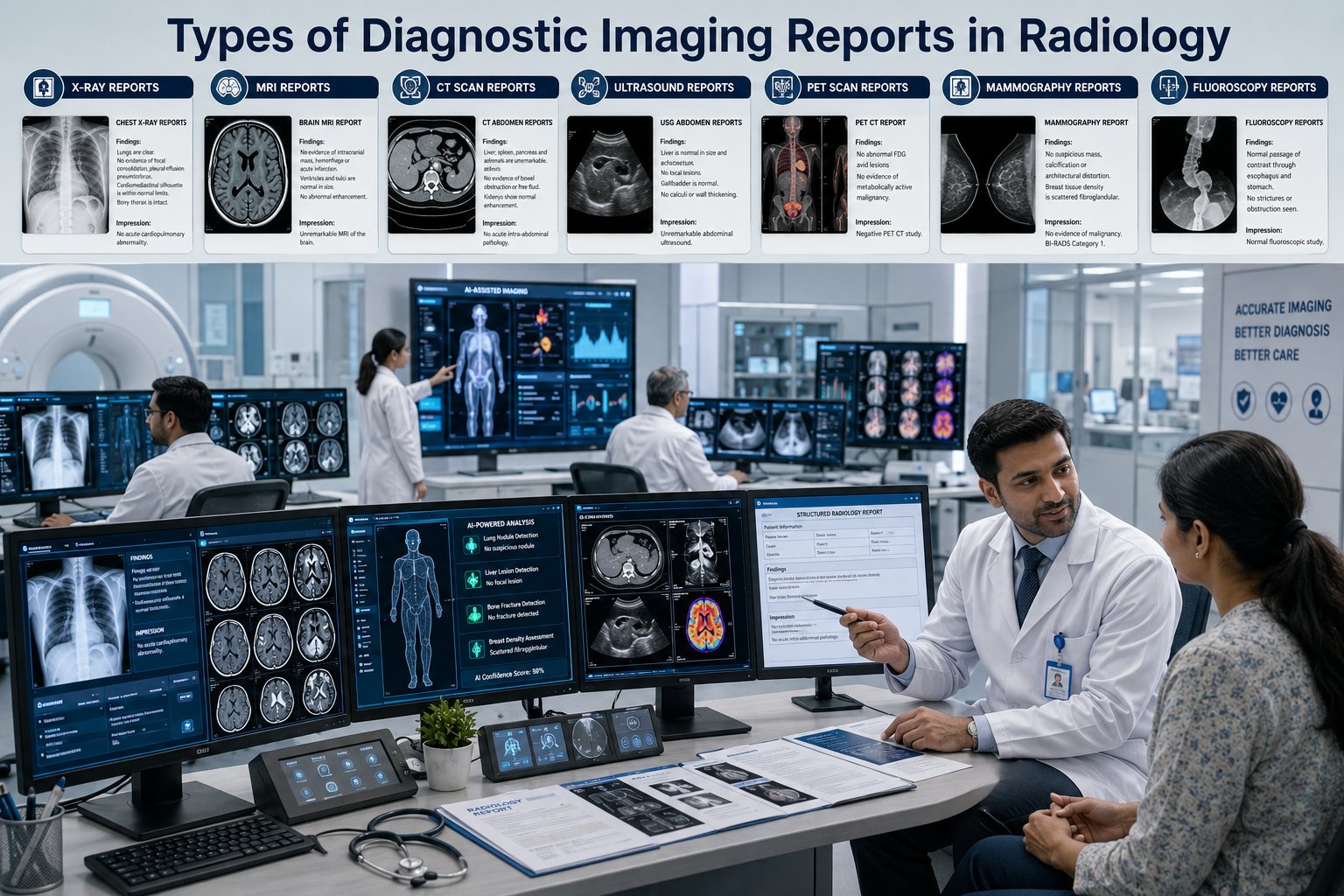
Radiology plays a major role in modern healthcare by helping physicians diagnose injuries, diseases, and medical conditions accurately. Every imaging procedure performed in a healthcare facility requires a detailed report that explains the findings clearly. These reports are essential for patient treatment, follow-up care, and medical documentation. Because of the increasing demand for accurate documentation, healthcare providers now rely heavily on Diagnostic Imaging Transcription Services, Radiology Transcription Services, and Diagnostic Report Typing Services to improve reporting quality and workflow efficiency.
Diagnostic imaging reports are prepared after interpreting medical scans such as X-rays, CT scans, MRI scans, ultrasounds, mammograms, and nuclear imaging studies. Each report type has a unique structure and purpose depending on the imaging modality used. Accurate transcription ensures the final report is error-free, properly formatted, and quickly delivered to physicians.
Diagnostic imaging reports are one of the most important communication tools between radiologists and physicians. A properly written report helps doctors understand the patient’s condition and determine the right treatment plan.
Healthcare organizations use Radiology Transcription Services to ensure reports are delivered with high accuracy and within a short turnaround time. Efficient reporting improves patient care, reduces delays, and enhances hospital productivity.
Benefits of professional reporting services include:
X-ray reports are among the most commonly generated radiology reports. These reports help diagnose fractures, infections, arthritis, chest conditions, and bone abnormalities.
An X-ray report generally includes:
Hospitals and diagnostic centers often depend on Diagnostic Report Typing Services for accurate X-ray report documentation and quick processing.
Computed Tomography (CT) scan reports provide detailed cross-sectional images of the body. CT scans are commonly used to diagnose tumors, internal injuries, infections, and vascular diseases.
A CT report includes:
Accurate CT reporting is essential because even a small transcription error can affect patient diagnosis. This is why many healthcare providers use Diagnostic Imaging Transcription Services to maintain quality and precision.
MRI reports are highly detailed because Magnetic Resonance Imaging provides comprehensive images of soft tissues, muscles, organs, and nerves.
MRI reports are commonly used for:
Professional Radiology Transcription Services help radiologists complete complex MRI documentation accurately while reducing reporting delays.
Ultrasound reports are created using sound-wave imaging technology. These reports are frequently used in obstetrics, abdominal imaging, cardiac evaluation, and vascular studies.
Ultrasound reports usually contain:
Because ultrasound examinations generate detailed observations, many facilities use Diagnostic Report Typing Services for organized and accurate reporting.
Mammography reports are specialized radiology reports used for breast cancer screening and diagnosis. These reports follow standardized reporting formats such as BI-RADS classifications.
A mammography report may include:
Accurate mammography transcription is extremely important for early cancer detection and patient safety.
Nuclear medicine reports analyze body functions using radioactive tracers. These reports help diagnose conditions involving the thyroid, bones, heart, kidneys, and lungs.
Typical components include:
Healthcare providers use Diagnostic Imaging Transcription Services to ensure these technically detailed reports are accurately documented.
Most radiology reports follow a standard structure to improve clarity and communication. The common sections include:
Professional Radiology Transcription Services ensure every section is properly documented and formatted for easy physician review.
Radiologists handle a large number of imaging studies every day. Managing reports manually can be time-consuming and increase the risk of documentation errors. This is where Diagnostic Imaging Transcription Services become highly valuable.
These services help healthcare providers by:
Professional transcription teams understand medical terminology, radiology abbreviations, and formatting standards, ensuring high-quality documentation.
Accurate reports reduce medical errors and support better patient treatment decisions.
Quick report delivery helps physicians begin treatment sooner and improves hospital efficiency.
Outsourcing transcription services reduces staffing costs and administrative workload.
Timely and accurate reports improve communication between radiologists and physicians, leading to better patient outcomes.
Reliable transcription providers follow HIPAA compliance standards to protect patient confidentiality.
Technology continues to transform radiology reporting through voice recognition software, AI-assisted documentation, and cloud-based reporting systems. However, human transcription expertise remains essential for maintaining accuracy and quality control.
Healthcare organizations continue to rely on Radiology Transcription Services and Diagnostic Report Typing Services to support efficient reporting systems while handling increasing patient volumes.
As diagnostic imaging becomes more advanced, the demand for professional transcription support will continue to grow across hospitals, clinics, and imaging centers worldwide.
Diagnostic imaging reports are essential for accurate diagnosis, treatment planning, and patient care. From X-rays and CT scans to MRI and ultrasound reports, every imaging study requires precise documentation and interpretation.
Professional Diagnostic Imaging Transcription Services, Radiology Transcription Services, and Diagnostic Report Typing Services help healthcare organizations maintain accuracy, improve turnaround time, and streamline radiology workflows. By using reliable transcription support, medical facilities can enhance productivity while delivering better healthcare outcomes for patients.
Diagnostic imaging reports are medical documents that explain findings from scans like X-rays, CT scans, MRI, and ultrasounds.
They help improve report accuracy, reduce turnaround time, and support efficient healthcare documentation.
A radiology report usually includes patient details, imaging technique, findings, and diagnostic impression.
They streamline workflow, reduce documentation burden, and improve patient care through accurate reporting.
These services convert dictated radiology notes into professionally formatted medical reports.