

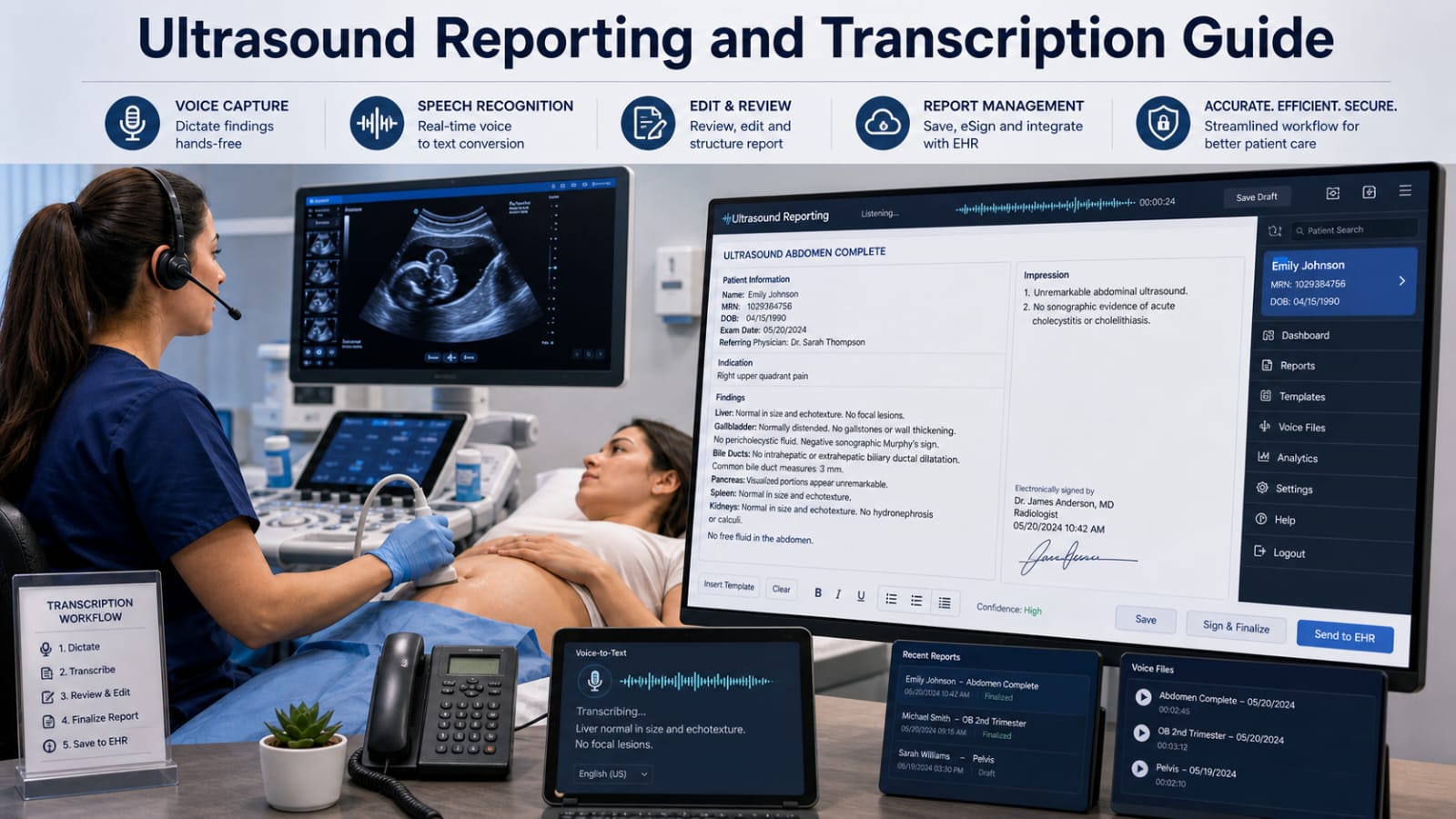
Ultrasound imaging is one of the most widely used diagnostic tools in modern healthcare due to its safety, speed, and real-time imaging capabilities. From obstetrics to cardiology, ultrasound plays a crucial role in identifying medical conditions early. However, the diagnostic value of ultrasound depends not only on image quality but also on how accurately the findings are documented and communicated.
This is where Ultrasound Report Transcription becomes essential. Proper transcription ensures that every observation made by the radiologist is captured clearly and translated into a structured, readable report. With the support of Radiology Transcription Services and Radiology Documentation Services, healthcare providers can ensure consistency, accuracy, and efficiency in their reporting workflows.
Ultrasound reporting is the process of interpreting diagnostic images and converting them into detailed written reports. These reports are used by referring physicians to make critical treatment decisions.
A high-quality report is not just a summary—it is a complete clinical document that reflects the radiologist’s expertise. Proper Radiology Medical Record Documentation ensures that patient data is recorded in a standardized format that can be easily accessed and understood by healthcare professionals.
Including these elements ensures clarity and strengthens Radiology Documentation Services across healthcare systems.
Accurate transcription is the backbone of effective radiology reporting. Even a small error in wording or measurement can significantly impact patient care.
In busy clinical environments, radiologists rely heavily on Radiology Transcription Services to ensure their dictated notes are captured correctly. These services not only improve accuracy but also reduce the administrative burden on healthcare professionals.
Accurate Ultrasound Report Transcription ultimately contributes to better healthcare outcomes and improved trust in medical documentation.
The transcription process is a multi-step workflow designed to deliver precise and timely reports. Each step plays a crucial role in maintaining quality and consistency.
This process ensures that Radiology Medical Record Documentation meets both clinical and administrative standards.
1. Use Structured Templates
Templates reduce variability and improve readability in Radiology Documentation Services.
2. Focus on Clear Communication
Reports should be easy to understand, avoiding unnecessary jargon while maintaining clinical
precision.
3. Maintain Consistency
Standard terminology ensures uniformity across reports and improves collaboration among
healthcare providers.
4. Prioritize Timeliness
Quick turnaround times are essential, especially in emergency cases where decisions must be made
rapidly.
5. Partner with Experts
Using professional Radiology Transcription Services ensures high-quality Ultrasound Report
Transcription.
Technology continues to reshape the field of radiology documentation. Advanced tools are now used to enhance both speed and accuracy.
Modern Radiology Documentation Services often incorporate:
While automation improves efficiency, human expertise remains essential to ensure context, accuracy, and proper formatting in Radiology Medical Record Documentation.
Outsourcing transcription has become a strategic decision for many healthcare providers.
By leveraging Radiology Transcription Services, organizations can focus more on patient care while maintaining high-quality documentation.
Despite advancements, several challenges still exist in ultrasound reporting.
Professional Radiology Documentation Services address these issues through trained transcriptionists and robust quality control processes.
Continuous improvement is essential for maintaining excellence in ultrasound reporting.
These measures ensure consistent and accurate Ultrasound Report Transcription while strengthening overall Radiology Medical Record Documentation.
The future of ultrasound reporting is driven by innovation and digital transformation.
Emerging trends include:
As technology evolves, Radiology Transcription Services will continue to play a vital role in ensuring accuracy and reliability.
Ultrasound reporting and transcription are critical components of modern healthcare documentation. Accurate reporting ensures better diagnosis, improved patient outcomes, and seamless communication among healthcare professionals.
By adopting best practices, leveraging advanced tools, and utilizing expert Radiology Transcription Services, healthcare providers can significantly enhance the quality of Radiology Documentation Services and maintain reliable Radiology Medical Record Documentation.
It converts dictated ultrasound findings into structured written reports.
They ensure accurate, fast, and standardized documentation.
It includes transcription, editing, formatting, and record management.
It provides clear reports that support accurate diagnosis and treatment.
It is the structured recording of radiology findings for clinical and legal use.