

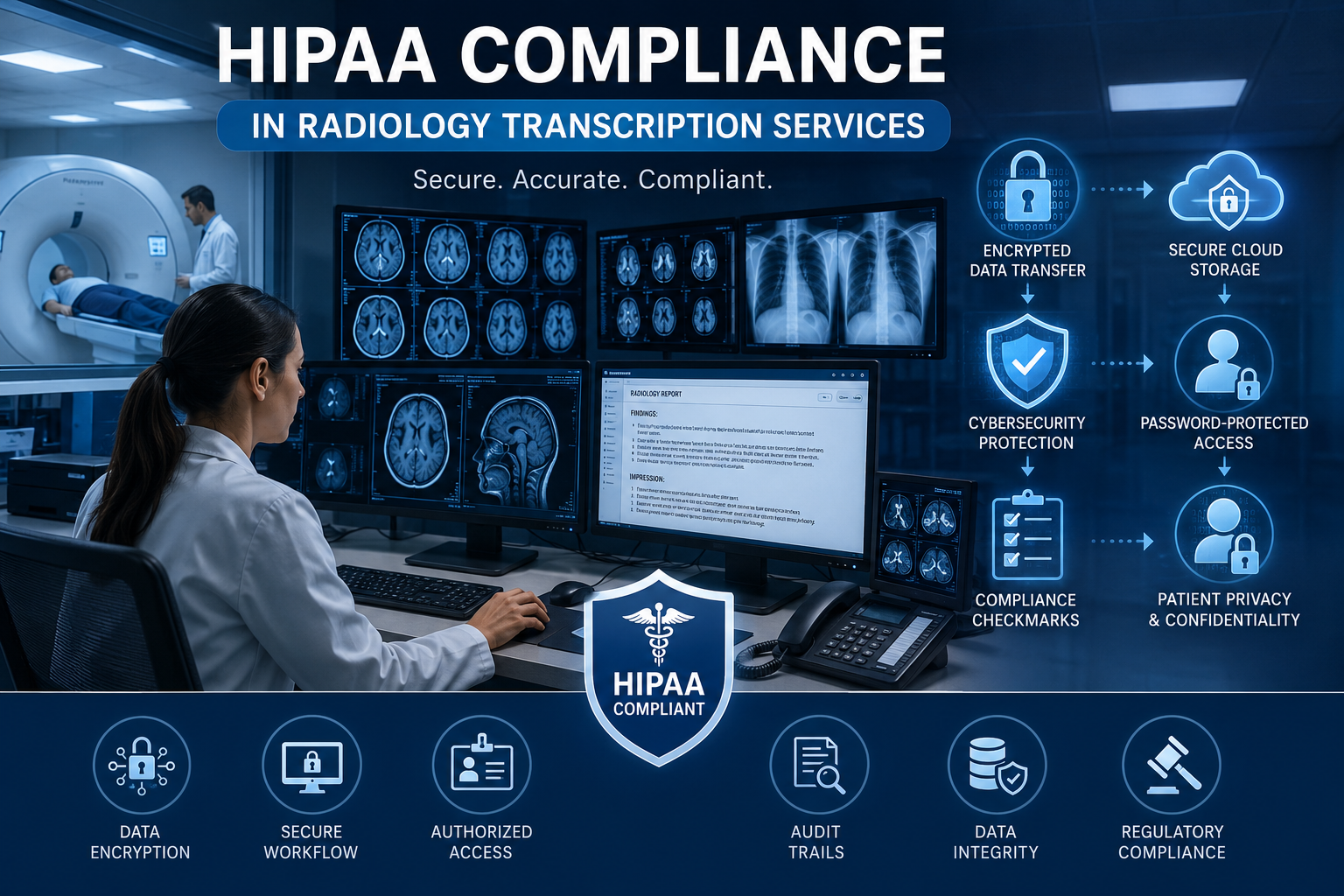
Healthcare organizations handle enormous amounts of sensitive patient information every day. In radiology departments, medical imaging reports contain critical diagnostic findings, patient identifiers, physician notes, and treatment recommendations. This is where HIPAA Compliant Radiology Transcription plays a crucial role.
Radiology transcription services convert dictated radiology findings into accurate, structured, and secure reports. However, maintaining compliance with the Health Insurance Portability and Accountability Act (HIPAA) is essential to ensure patient privacy and data protection. Healthcare providers, imaging centers, and radiology groups must work with transcription partners that understand and follow HIPAA regulations.
In this article, we will explore the importance of HIPAA compliance in radiology transcription, the risks of non-compliance, and how professional Radiology Report Transcription, Radiology Reporting Services, and Radiology Report Healthcare organisations can retain efficiency and security by using formatting services
HIPAA was established to protect sensitive patient health information from unauthorized access, disclosure, or misuse. Any organization that handles Protected Health Information (PHI) must comply with strict privacy and security standards.
Radiology reports typically contain:
Because radiology reports contain highly sensitive data, transcription providers must implement comprehensive safeguards to ensure compliance.
A HIPAA-compliant transcription workflow protects patient information during:
Healthcare organizations run a serious danger of financial penalties, reputational harm, and data breaches if they don't have adequate security.
Radiology departments generate thousands of reports every month. Even a single security incident can expose confidential patient information and result in serious legal consequences.
Patient trust is fundamental in healthcare. HIPAA compliance ensures that sensitive medical information remains confidential and accessible only to authorized personnel.
HIPAA violations can lead to substantial fines and regulatory investigations. Working with a compliant transcription provider helps reduce these risks.
Secure systems prevent unauthorized access, cyberattacks, and accidental disclosures of patient records.
Healthcare providers can focus on patient care knowing their transcription processes meet regulatory requirements.
Accurate and secure Radiology Report Transcription ensures physicians receive timely reports for diagnosis and treatment planning.
Professional Radiology Reporting Services follow several critical HIPAA requirements.
These include policies and procedures designed to manage security risks.
Physical safeguards protect hardware and facilities.
Technical protections secure electronic health information.
These safeguards help ensure patient information remains protected throughout the transcription process.
A professional HIPAA Compliant Radiology Transcription workflow typically includes several security-focused stages.
Audio files are encrypted before transmission.
Encrypted channels prevent unauthorized access.
Experienced professionals create structured reports while maintaining confidentiality.
Reports undergo multiple quality checks for accuracy and consistency.
Reports are delivered and archived using protected systems with restricted access controls.
Proper report formatting is often overlooked but plays a significant role in clinical efficiency.
Professional Radiology Report Formatting Services help create reports that are:
Well-formatted reports reduce confusion and improve communication between radiologists, referring physicians, and specialists.
| Section | Purpose |
|---|---|
| Patient Information | Identifies the patient and examination |
| Clinical History | Provides relevant medical background |
| Procedure Details | Describes imaging performed |
| Findings | Documents imaging observations |
| Impression | Summarizes key diagnostic conclusions |
| Recommendations | Suggests follow-up actions if needed |
A standardized format improves readability and supports faster clinical decision-making.
Unauthorized access to patient records can result in large-scale privacy violations.
HIPAA violations can lead to substantial fines depending on the severity and duration of non-compliance.
Patients expect healthcare organizations to protect their information. Security incidents can erode trust and credibility.
Investigations, audits, and remediation efforts consume valuable time and resources.
Organizations may face lawsuits and regulatory actions following data breaches.
These risks highlight the importance of choosing a trusted transcription partner committed to HIPAA standards.
When evaluating transcription providers, healthcare organizations should look for the following:
Transcriptionists and editors should receive regular HIPAA training and compliance updates.
The provider should use encrypted systems and secure communication channels.
All personnel handling patient information should sign confidentiality agreements.
Strong quality control procedures improve report accuracy and consistency.
Comprehensive audit logs help track system activity and maintain accountability.
A HIPAA-compliant vendor should provide a Business Associate Agreement outlining responsibilities for protecting PHI.
Modern Radiology Reporting Services offer benefits beyond compliance.
Timely report delivery helps physicians make faster treatment decisions.
Experienced transcriptionists understand complex radiology terminology and reporting standards.
Outsourcing transcription allows radiologists to focus more on patient care and image interpretation.
Structured reports integrate more effectively with electronic health record systems.
Professional transcription providers can handle fluctuating report volumes without compromising quality.
Pro Tip: When selecting a transcription vendor, ask about encryption standards, audit logs, employee HIPAA training, and Business Associate Agreements (BAAs). A provider that openly discusses security measures is more likely to maintain strong HIPAA compliance and protect patient data effectively.
As healthcare technology continues to evolve, radiology transcription services are becoming more advanced. Artificial intelligence, speech recognition, cloud-based workflows, and electronic health record integration are improving productivity.
However, regardless of technological advancements, HIPAA compliance remains essential. Healthcare organizations must ensure that every innovation is supported by strong security controls and privacy protections.
Combining advanced technology with experienced transcription professionals creates a reliable solution that improves report accuracy, efficiency, and regulatory compliance.
HIPAA Compliant Radiology Transcription is essential for protecting patient information, maintaining regulatory compliance, and supporting high-quality healthcare delivery.. From secure dictation and encrypted file transfers to accurate Radiology Report Transcription, professional Radiology Reporting Services, and standardized Radiology Report Formatting Services, every step of the process contributes to patient privacy and clinical efficiency.
Healthcare providers that partner with HIPAA-compliant transcription companies can reduce risk, improve workflow performance, and maintain the trust of patients and healthcare professionals alike.As data security concerns continue to grow, investing in secure and compliant radiology transcription solutions is more important than ever.
HIPAA Compliant Radiology Transcription refers to the secure transcription of radiology reports while following HIPAA regulations to protect patient health information.
HIPAA compliance ensures patient privacy, prevents data breaches, reduces legal risks, and protects healthcare organizations from regulatory penalties.
Common measures include encryption, secure file transfers, access controls, audit logs, multi-factor authentication, and employee HIPAA training.
They create structured, consistent reports that are easier to read, improve physician communication, and support EHR integration.
Providers should look for HIPAA compliance, secure technology, experienced transcriptionists, quality assurance processes, and a signed Business Associate Agreement (BAA).