
In today’s fast-paced healthcare environment, accurate and efficient documentation is critical. The Radiology Documentation Workflow Explained process plays a vital role in ensuring that imaging results are properly recorded, interpreted, and communicated. From capturing patient data to generating final reports, every step must be streamlined to avoid delays and errors.
With increasing reliance on digital systems and growing patient volumes, healthcare providers are turning to Radiology Documentation Services to enhance efficiency and maintain compliance. This blog breaks down the complete workflow and highlights how proper documentation supports better clinical outcomes.
The radiology documentation workflow refers to the structured process of recording, managing, and storing patient imaging data and reports. It includes everything from order entry to final report delivery.
The workflow begins when a physician orders a radiology exam. Patient details, clinical history, and test requirements are recorded in the system.
This step is crucial for Radiology Medical Record Documentation because:
Once the order is placed, the procedure is scheduled. Patients may receive preparation instructions depending on the type of imaging (e.g., MRI, CT scan).
Proper scheduling contributes to:
During this stage, radiologic technologists capture images using advanced imaging equipment. Accuracy here directly impacts the quality of diagnosis.
Key points:
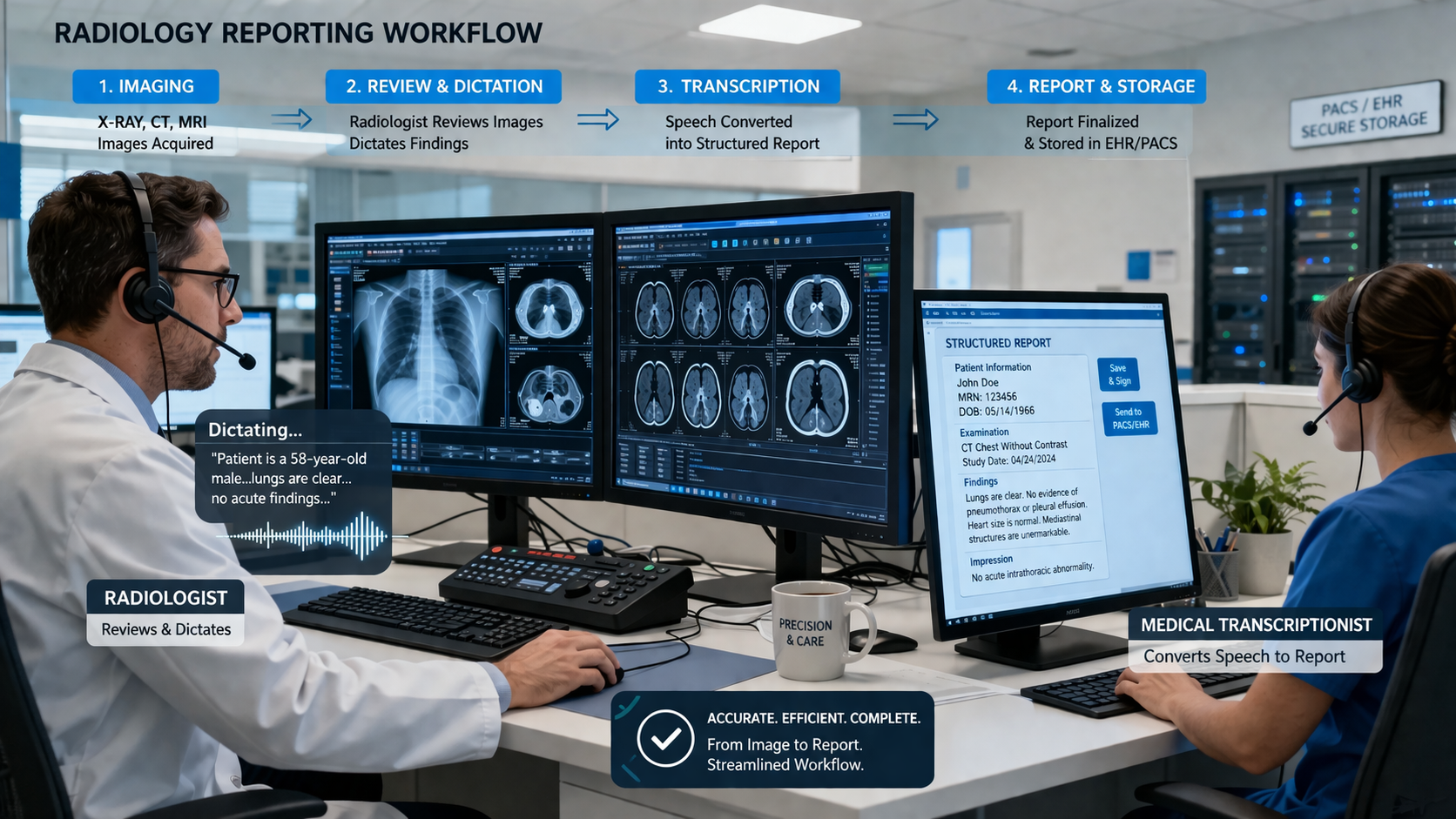
Radiologists review the images and analyze findings. This is one of the most critical steps in the Radiology Documentation Workflow Explained process.
They:
Radiologists dictate their findings, which are then transcribed into structured reports. This is where Radiology Documentation Services play a major role.
Benefits include:
Professional transcription ensures high-quality Radiology Medical Record Documentation, minimizing the risk of misinterpretation.
Once transcribed, reports undergo proofreading and quality checks. Accuracy is essential to maintain the integrity of Radiology Clinical Documentation.
Quality assurance involves:
After approval, the final report is shared with the referring physician and added to the patient’s medical records.
Efficient delivery ensures:
The final step involves storing reports and images securely for future reference. This is a key aspect of Radiology Workflow Documentation.
Benefits:
A well-structured workflow offers multiple benefits:
Accurate documentation reduces diagnostic errors and enhances patient safety.
Streamlined processes ensure reports are delivered quickly, aiding timely treatment.
Clear documentation improves collaboration between radiologists and physicians.
Proper Radiology Medical Record Documentation ensures adherence to healthcare regulations.
Despite its importance, healthcare providers often face challenges such as:
These challenges highlight the need for professional Radiology Documentation Services to optimize workflow efficiency.
Outsourcing or using specialized services can significantly enhance workflow performance.
Advanced tools streamline Radiology Workflow Documentation, reducing manual effort.
Experienced transcriptionists ensure accurate Radiology Clinical Documentation.
Services can handle large volumes without compromising quality.
Outsourcing reduces operational costs while maintaining high standards.
To optimize the workflow, healthcare providers should follow these best practices:
These strategies improve both Radiology Medical Record Documentation and overall efficiency.
The future of Radiology Documentation Workflow Explained lies in digital transformation and AI integration.
These innovations will further enhance Radiology Clinical Documentation and streamline processes across healthcare systems.
Understanding the Radiology Documentation Workflow is essential for healthcare providers aiming to deliver accurate and timely patient care. From patient registration to final report archiving, every step plays a crucial role in maintaining high-quality documentation.
By leveraging professional Radiology Documentation Services, healthcare organizations can overcome challenges, improve efficiency, and ensure reliable workflow processes. Strong documentation practices ultimately lead to better clinical outcomes and enhanced patient satisfaction.
It is the step-by-step process of recording, managing, and delivering radiology reports.
It ensures accurate diagnosis and effective communication between healthcare providers.
They improve accuracy, reduce turnaround time, and streamline reporting processes.
It includes patient data, imaging reports, diagnostic findings, and archived records.
By using automation tools, standardized templates, and professional transcription services.